
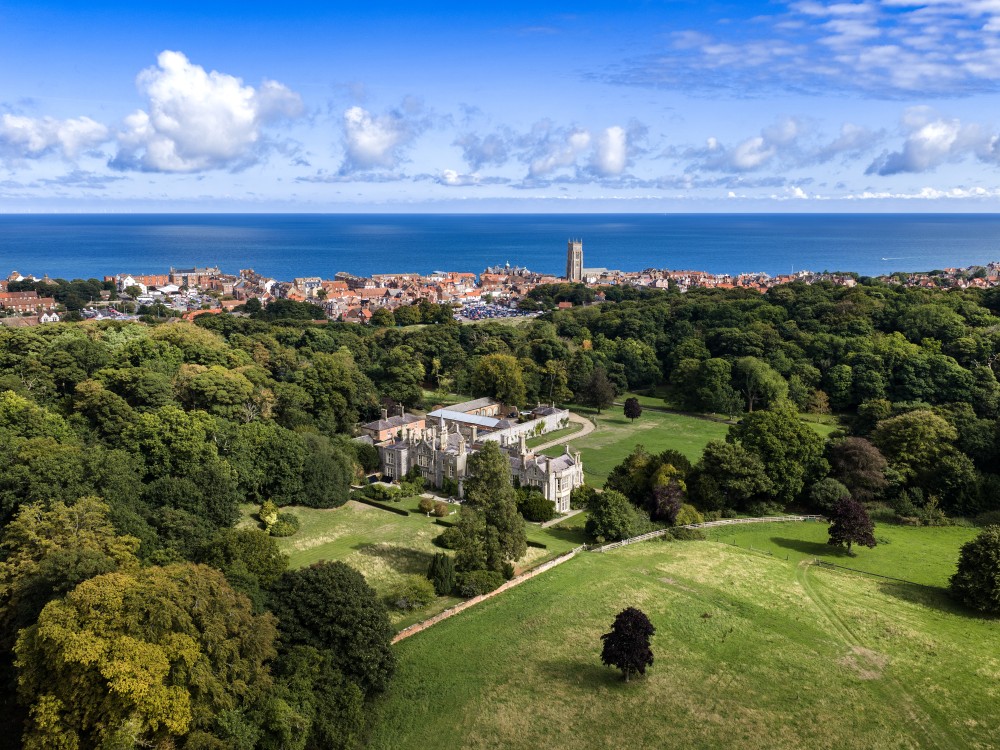
Behind the gates of Cromer Hall
From literary legends to a legacy woven into the town itself, discover the stories behind one of Norfolk’s most intriguing private homes
In a secluded valley, framed by the bright blue of the Cromer coastline, stands Cromer Hall. Built in the late 1820s by architect William Donthorn, it remains a defining example of Gothic Revival architecture and one of the most atmospheric stately homes in the county.
With its asymmetrical silhouette, decorative flushwork entrance and intricate interior woodwork, Cromer Hall was never intended to be a faithful recreation of medieval design. Instead, it represents a highly imaginative interpretation of the Gothic style, combining drama, romance and craftsmanship to create a house of remarkable character.

The estate was purchased in 1852 by Benjamin Bond Cabbell for £64,000, establishing a family connection that continues to this day. Given the Cabbell family’s rich 300-year history, it is little surprise that Cromer Hall has borne witness to love, tragedy, war and even played a part in the origins of one of the world’s most famous novels.
Following a trip to South Africa, during which he contracted enteric fever, Sir Arthur Conan Doyle chose Norfolk as a place to recuperate. Accompanied by his friend, journalist Bertram Fletcher Robinson, he spent time golfing in the county and became fascinated by its stories and legends.
According to local tradition, the coachman who drove Conan Doyle to Cromer Hall bore the surname Baskerville, a curious coincidence given what would later become one of the author’s most celebrated novels, The Hound of the Baskervilles.
During a dinner at Cromer Hall with a later Benjamin Bond Cabbell, a relative and namesake of the man who purchased the estate, Conan Doyle is said to have heard the story of a spectral hound that haunted a Cabbell ancestor. That ancestor was Richard Cabell of Buckfastleigh, whose dark tale bears striking similarities to that of the fictional Hugo Baskerville.
“The version told to Conan Doyle was that Richard Cabell believed his wife to be unfaithful and beat her mercilessly. He pursued her across Dartmoor, near his estate, and stabbed her to death,” says Benji Cabbell Manners, the current owner of Cromer Hall. “As he committed the murder, a hound flew at his throat and ripped it out. Both man and dog fell dead, but its spirit was left to prowl the moors and reappear to each generation of the Cabell family.”

The Cabbell legend was not the only local influence on Conan Doyle. The tale of Black Shuck, Norfolk’s infamous phantom hound whose glowing red eyes were said to foretell death, has also become entwined with the origins of the novel. Even Conan Doyle’s description of Baskerville Hall, complete with towers, flintwork and an imposing central entrance, bears an uncanny resemblance to the house that still overlooks Cromer today.
The relationship between Cromer and its Hall has long been a mutually enriching one, with each helping to shape the identity and heritage of the other.
For generations, the family at Cromer Hall has maintained strong ties with the local community. Among the most significant contributions was that of Benjamin Bond Cabbell, who funded the renovation of Cromer’s Royal National Lifeboat Institution facilities in 1867.
“He donated more than £1,000, which paid for a new lifeboat, boathouse, slipway and an extension to the sea wall,” Benji explains. “The two Benjamin Bond Cabbell lifeboats launched 21 times and saved 57 lives.”
The family’s support extended inland. In 1862, as efforts began to restore Cromer’s parish church, the Cabbell family joined other local residents in helping to fund the project. Benjamin Bond Cabbell’s legacy remains visible today, most notably in the church’s magnificent hammerbeam roof and four stained-glass windows.

Cromer Hall has not survived simply because it was left untouched. It has endured through continual repair, rebuilding and adaptation.
In recent years, the Cabbell Manners family has sought new ways to diversify the estate while sharing its striking setting with the wider public. The grounds have become a popular venue for concerts, and this summer saw the estate host its first open‑air performance, which proved a great success.
The estate is also home to Amazona Zoo, purchased by Benji in 2014 as part of its ongoing evolution. Looking ahead, plans for weddings and clay shooting experiences promise to open this historic corner of Cromer to even more visitors.
Despite its rich history, wealth and legacy, Cromer Hall retains its privacy. When asked what the Hall means to both Benji and his son Hughie Cabbell Manners, they each replied with the same word: “home.”
It’s a simple answer, but a fitting one. For all its architectural significance, literary connections and place within Norfolk’s heritage, Cromer Hall remains first and foremost a family home.