
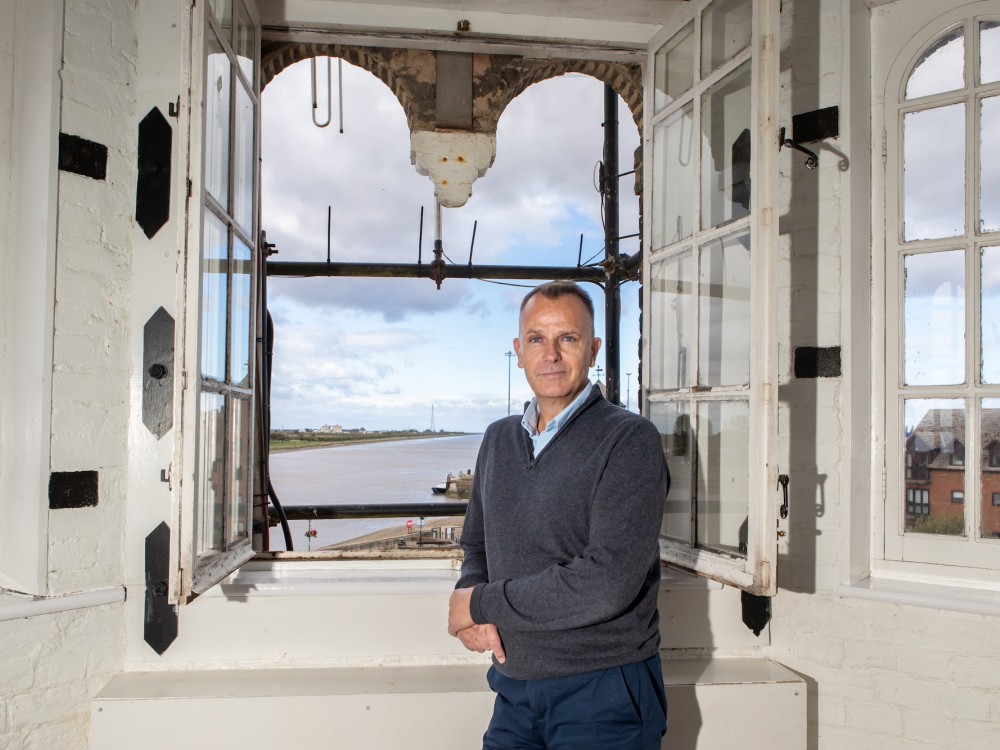
Watching over The Wash
Captain Patrick Jary masters the shifting channels of one of England’s most challenging working ports.
In the grey pre-dawn light of King’s Lynn harbour, where the Great Ouse meets the unpredictable waters of The Wash, Captain Patrick Jary begins another day coordinating one of England’s most complex shipping operations. As Harbour Master and Chief Executive of the King’s Lynn Conservancy Board (the town’s port authority), he shoulders responsibility for a busy tidal hub. More than 400,000 tonnes of cargo, carried by 190 vessels each year, depend on his ability to read these ever-changing waters.
Patrick brings four decades of maritime experience to the role. He began as a 16-year-old deck boy, walking down to the docks and stepping aboard a ship to ask for work. That bold start launched a distinguished journey through the Merchant Navy, where he rose steadily to the rank of captain before joining the team at King’s Lynn’s port as a pilot in 1998, eventually returning to take the lead as Harbour Master.
Guiding large cargo vessels into port is far more complex than it appears to observers from the shore. “Every ship you board is different,” Patrick explains. “You encounter crews from all nationalities, each with their own personalities. You need technical skill, confidence
and awareness to handle every situation safely.”
The ships he pilots typically carry 2,500 tonnes of cargo and stretch up to 120 metres long. They bring timber from Baltic ports, salt and stone and occasionally more unusual items such as massive wind turbine blades or 400-tonne electrical transformers. Norfolk’s own harvest also flows back through the port, including malted barley bound for Scottish whisky distilleries and grain shipped to the continent.
“A single vessel can replace 100 lorries,” Patrick notes. “The environmental and logistical benefits are huge.”
Yet the greatest challenge lies not in the cargo but in The Wash itself. Tidal flows constantly reshape its channels, shifting silt from salt marshes and mudflats.
“Nature gives you a load of work to do,” Patrick says. “It can shut one channel you’re using and open another. We’ve had to change approach routes completely, moving buoys and markers. It’s a massive undertaking.”
The buoys visible from King’s Lynn’s shoreline form part of a sophisticated navigation system that Patrick’s team constantly monitors.
“If a buoy goes adrift or a light fails, we must act within 48 hours to keep water users safe,” he explains.
The port relies on 46 buoys and 12 beacons, each built to strict international standards. Green cone-shaped markers guide vessels on the starboard side, while red can-shaped buoys mark the port side. Each cost more than £1,000 and is powered by solar panels that require regular maintenance.

Among these markers are more unusual guides too. The Roaring Middle Light Vessel, a historic ship now permanently anchored, has been steering vessels through The Wash for more than a century. It remains the largest and brightest navigation light in these waters, representing a unique piece of seafaring heritage that continues to serve mariners today.
While technology has transformed navigation since the port’s Victorian origins, the fundamentals remain.
“The core safety work hasn’t changed at all,” Patrick reflects. “We’re still bringing ships in, marking channels and measuring depths. We use echo sounders and laptops now, but a century ago they did the same job with a lead line.”
At times, conditions require the team to return to more traditional methods. “Digital equipment can struggle with water density or tidal conditions, so we go out at low tide with sounding poles,” Patrick explains. “At seven o’clock on a January morning, working on mudflats in the cold is far from ideal, but it has to be done.”
Patrick takes pride in the dedicated team he works alongside. The port’s experienced Deputy Harbour Master, three pilots and three coxswains are all Norfolk natives who chose to return home rather than pursue nautical careers elsewhere.
Looking ahead, however, Patrick’s greatest concern is attracting new talent. “Every port authority is struggling to bring in maritime professionals,” he admits. “We need to think differently about developing skills for the future. It’s about creating good jobs and building a workplace where people feel valued.”
After a lifetime at sea and nearly nine years as Harbour Master, Patrick still finds satisfaction in keeping port operations running safely.
“I love to get stuck into the practical work and hop on a ship whenever I can,” he says with a smile. “That’s what drew me to this career in the first place, and I still like to get away from the paperwork and onto the water as much as possible.”
This combination of tradition and modern responsibility defines Patrick’s role - ensuring that The Wash continues to serve as a vital gateway to the world, one carefully navigated ship at a time.
