
Creatures of the deep
More than a beach-day curiosity, the jellyfish drifting through Norfolk’s waters are ancient survivors with a story to tell
Look carefully into the shallows on a Norfolk beach this summer and you may spot something extraordinary: an alien-like creature pulsing gently through the water, trailing delicate tendrils beneath a translucent bell. Jellyfish have captivated and unsettled beachgoers in equal measure for generations, and their truth is even stranger and more wonderful than it first appears.
A jellyfish has no brain, no blood, no heart, and is 95% water. Its digestive system is so simple that the same opening serves as both mouth and waste outlet. Yet despite this simplicity, jellyfish have been drifting through the world’s oceans for around 500 million years, with fossilised imprints confirming their design has barely changed in all that time.
Anna Bunney, Citizen Science Programme Developer at the Marine Conservation Society, has spent years helping the public engage with these remarkable creatures. “They’re strange, but they’re amazing,” she says. “They’re what we call passive drifters rather than powerful swimmers. They move by rhythmically opening and closing their bell to create a current, drawing prey like plankton, fish eggs, shrimps and even other jellyfish within reach of their stinging tentacles.”
Washed by the North Sea and warmed each summer by the Gulf Stream, Norfolk’s coastline plays host to a variety of jellyfish species. Sightings typically increase from May onwards, and any of the six species most commonly found in UK waters could appear along these shores.
The barrel jellyfish is the one most likely to stop beachgoers in their tracks. “It can grow up to a metre in diameter, roughly the size of a dustbin lid,” Anna explains. “Its milky white bell and frilly, purple-edged oral arms make it unmistakable, but it delivers only a mild sting.”
The moon jellyfish is perhaps the most familiar of all UK species. Its translucent, saucer-shaped bell reveals four distinctive horseshoe shapes at its centre, usually pink or purple in colour, and its sting is barely perceptible. It’s frequently seen in large numbers, with nearly a quarter of all moon jellyfish sightings recorded by the Marine Conservation Society involving groups of 100 or more.
The compass jellyfish is easy to identify. Bold dark-brown, orange or red V-shaped markings radiate across its bell and long trailing tentacles extend beneath it. “This species delivers a genuinely painful sting, so keeping a respectful distance is advisable,” Anna warns. “The mauve stinger is another to avoid. It’s small and exquisitely beautiful in vivid pink and purple, but the sting it gives is disproportionate to its tiny 10cm frame.”
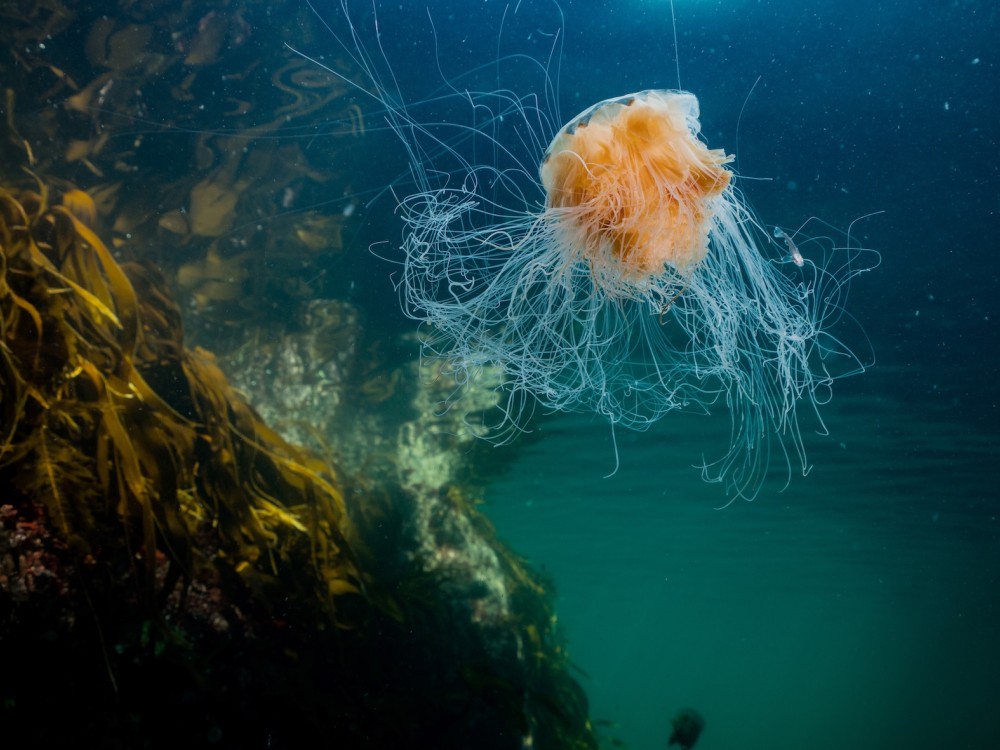
The blue jellyfish, with its deep violet dome and thick oral arms, is another regular visitor to Norfolk waters, while the lion’s mane jellyfish is the giant of our local species. Most measure around 50cm across, but they can reach an extraordinary two metres in diameter. A shaggy, reddish-brown bell surrounded by dense, hair-like tentacles gives this species its evocative name, and its severe sting makes it best admired from a distance.
“If you encounter a jellyfish in the water, just move away calmly,” Anna advises. “Leave any you spot stranded on the beach as you find them, both for your own sake and that of any curious dogs. That said, beached jellyfish do offer a rare chance to appreciate just how extraordinary they are up close - their colours, their tentacles and the quiet strangeness of them.”

Jellyfish seem to have become more prominent in recent summers, but the data does not support this popular perception. The Marine Conservation Society recorded 1,327 jellyfish sightings across the UK and Ireland between October 2024 and September 2025 – a 6% drop on the previous period. “Part of the impression of growing numbers may come from more people looking,” Anna explains. “Social media makes it feel like they’re everywhere, even if numbers haven’t dramatically increased.”
Another factor is the appearance of so-called ‘blooms’— dense concentrations of jellyfish, sometimes numbering in the hundreds. These form when plankton thrive in warm, nutrient-rich water, drawing jellyfish together to feed and reproduce.
What’s certain is that jellyfish act as valuable indicator species. Unusual increases in numbers, or earlier seasonal appearances, can signal changes in ocean temperature or wider ecosystem shifts. The Marine Conservation Society’s Jelly Watch programme invites the public to log their sightings online, with no specialist knowledge required. “It’s a really easy and fun micro-volunteering opportunity,” says Anna. “You can get the kids involved counting them and using the ID resources. It’s educational and it genuinely helps scientists.” Sightings can be submitted at mcsuk.org, where identification guides make distinguishing one species from another surprisingly straightforward.
Though most beachgoers might not want to get too close, jellyfish are beautiful and biologically extraordinary residents of Norfolk waters - ancient survivors quietly telling us something important about the health of our seas.
