
A heavenly sound
Singing the praises of the spectacular pipe organ that fills King’s Lynn Minster with beautiful music
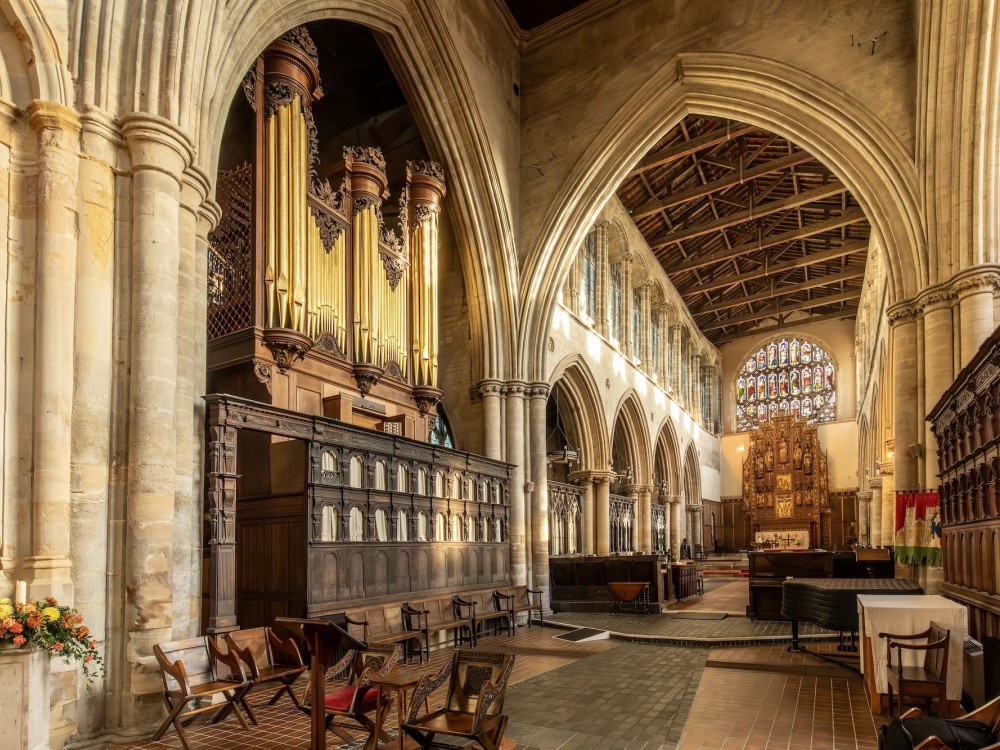
For nearly 1000 years, the magnificent Minster has shaped the life of King’s Lynn, enriching the town with its soaring presence and the treasures housed within its medieval walls. It stands as guardian of centuries of ecclesiastical craftsmanship, from intricate carvings to rare memorial brasses and, filling the north transept, the splendid 18th-century organ.
Visually stunning, with golden pipes that glisten in the sunlight, the organ is the beating heart and the musical soul of the Minster. Widely regarded as one of the finest instruments in the country, it represents a milestone in the history of British organ building.
“In Norfolk, our organ is second only to Norwich Cathedral,” explains Adrian Richards, the Minster’s Director of Music. “Nationally, few can rival it in size or in the depth and range of its sound - from the softest whisper to the thrilling, thunderous full volume. It’s also a beautiful and comfortable instrument to play.”
His admiration is shared by celebrated organists from across the UK and beyond, many of whom return each summer to perform in the Minster’s popular recital series. Among them is Professor David Baker, who travels from West Yorkshire every August.
“The grand organ at King’s Lynn Minster is a wonderful instrument, one of the best in Britain,” he says. “It offers a remarkable range of colour and character, from the intimacy of quiet, reflective music to the grandeur of Bach’s great compositions. It’s always a pleasure to perform in such a spectacular church, where the beauty of the building, the quality of the organ, and the warmth of the audience combine to create a very special musical occasion.”
Although the origins of the pipe organ can be traced back to ancient Greece, the first church organ described in detail was built at Winchester Cathedral during the 10th century. It was a vast contraption that needed two men to play it and 70 to operate the bellows, its sound carrying across the city.
Over time, organs became more practical and widely adopted in churches, winning the admiration of great musicians. Mozart himself famously declared: “In my eyes and ears the organ will forever be the king of instruments.”

Little is known about the earliest organs at the Minster until a second-hand instrument was installed at the west end in 1679. It suffered storm damage in 1741 but remained in service until the appointment of the celebrated musicologist and composer Dr Charles Burney. He was unimpressed, describing the organ as ‘execrably bad’, and persuaded the town’s leaders to raise £700 to commission a new instrument from the rising London maker Johannes Snetzler.
The decision proved an inspired investment. The Minster acquired one of the finest organs in the country, while Snetzler’s reputation was transformed. He went on to become one of the most sought-after organ builders of the 18th century and eventually organ maker to the King. The King’s Lynn instrument was his first large-scale commission, rivalled only by his later creation at Beverley Minster, which was slightly larger and contained more pipes, though fewer stops.
Snetzler drew on the artistic flair of his brother, Leonard, to create an organ case worthy of the Minster’s grand interior. The result was an elaborate rococo design that has endured through successive restorations, including a major rebuild in 1895 by Wordsworth and Co of Leeds, whose work largely shaped the instrument
we hear today.
The Millennium and the church’s 900th anniversary prompted further improvements, supported by fundraising, a generous legacy and the Heritage Lottery. These works included the restoration of the Snetzler case and the re-gilding of the façade pipes with 3,000 sheets of gold leaf.
The organ we now admire is the result of centuries of skill, care and devotion. It leads the choir at weekly choral evensong and the annual mayor-making ceremony as well as festival and remembrance services and the Minster’s uplifting Christmas celebrations. Its sound is both a gift to the ear and an unforgettable acoustic experience.
To discover who will be performing at the free summer recitals before they conclude at the end of September, explore upcoming events and learn more about the Minster’s history, visit kingslynnminster.org.