
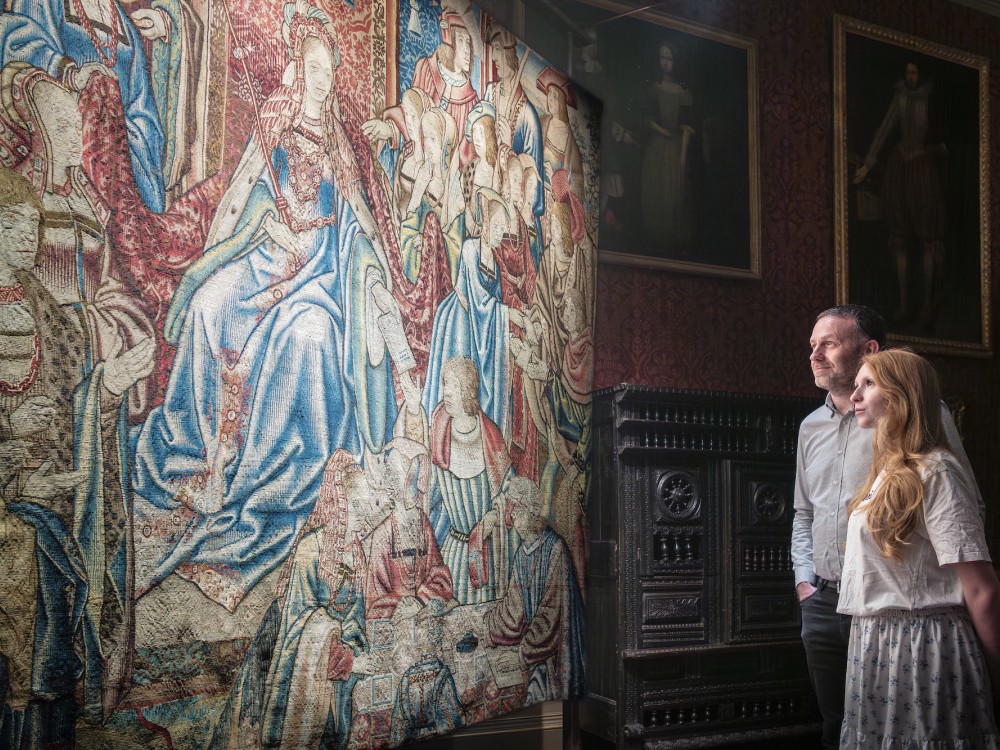
A Tudor treasure finds its way home
After more than a century out of sight, a remarkable 16th-century tapestry has returned to Oxburgh Estate, restoring a long-lost piece of its history
Home to the Bedingfeld family for over 500 years and one of the National Trust’s most treasured Norfolk properties, Oxburgh Hall has long been admired for its layered Tudor interiors, historic textiles and exquisite craftsmanship. Yet, as with many great houses, the collection that survives today is only a fragment of what once filled its rooms.
Every so often, when luck prevails, objects and works of art find their way home. Agnes Bedingfeld’s portrait did just that, recently reclaiming its place at Oxburgh after being discovered, long forgotten, in the attic. A similar twist of fortune has now brought back an enthralling tapestry, which resurfaced unexpectedly after more than a century away from the Bedingfeld home.
“It’s incredibly exciting to be able to bring home one of Oxburgh’s ‘lost’ heirloom tapestries,” says Shona Johnston, Property Experience Curator at Oxburgh Estate. “The return of ‘Queen Esther’ offers a once-in-a-generation opportunity to present an exceptionally significant and well-preserved artwork in its original setting.”
Believed to have been woven
in Brussels in the early 16th century, ‘Queen Esther’ is one of seven tapestries illustrating the Old Testament story of Esther and Ahasuerus. Each panel depicts a different moment in the narrative. All seven tapestries were sold by the Bedingfelds in 1924 with the other six yet to be accounted for.

“Many of these original Tudor spaces have been lost or altered by later generations, but the display of ‘Queen Esther’ provides a tangible link to Oxburgh’s historic Tudor interiors,” Shona explains. “Its beautiful, vibrant colours speak to the wealth and status of the Bedingfeld family in the early 16th century, when the tapestry most likely dates from.”
The return of this remarkable artwork also casts light on a more difficult period in Oxburgh’s past. Although the collection was built during a period of wealth and confidence, long before Catholicism was outlawed, the estate’s later financial struggles led to the sale of many prized heirlooms, including the tapestry series.
Sold separately from the other six tapestries in the series, ‘Queen Esther’ continued its extraordinary journey, spending time in Paris before reappearing in New York in 1992. After that, it vanished once again, slipping from view for almost three decades. Its whereabouts remained unknown until last spring, when National Trust Research Curator Jeremy Warren spotted it for sale at the TEFAF fine art fair in Maastricht, Netherlands.

“How many other countries she visited in the meantime, we might never know, but we are beyond delighted to welcome her back to Oxburgh Hall,” says Cultural Heritage Curator Lucy Armstrong-Blair. “Securing the funding at such short notice was a challenge, but everyone involved felt the pull of a truly great story. Esther’s return became more than an acquisition; it became an international effort to bring her home.”
Despite its age and extraordinary journey, the tapestry survives in strikingly intact condition. Its vivid colours suggest it may never have been displayed by previous owners, offering a rare, unspoilt glimpse of a 16th-century masterpiece. To protect it for generations to come, the National Trust’s conservation team has undertaken detailed checks, including micro-fade testing to assess how its pigments react to light.
“There will be ongoing conservation work to ensure that the colour and condition are preserved,” says Claire Golbourn of the National Trust’s Textile Conservation Studio. “This tapestry is of exceptional importance, and while the Trust holds several tapestries of a similar date, none match the style, quality or condition of Queen Esther.”
Now hanging in Oxburgh’s Saloon, the grand reception room at the heart of the house, the tapestry is a sight to remember. With no glass barrier surrounding it, every thread is revealed, picked out by specially designed lighting that shifts subtly throughout the day to highlight different details. Charlotte Bedingfeld’s fine 1819 sketches of four of the tapestries are displayed nearby, bringing more of the story of Esther and Ahasuerus back into view.
Visit Oxburgh Estate to discover more and see this woven wonder restored to the place it was always meant to be.
