
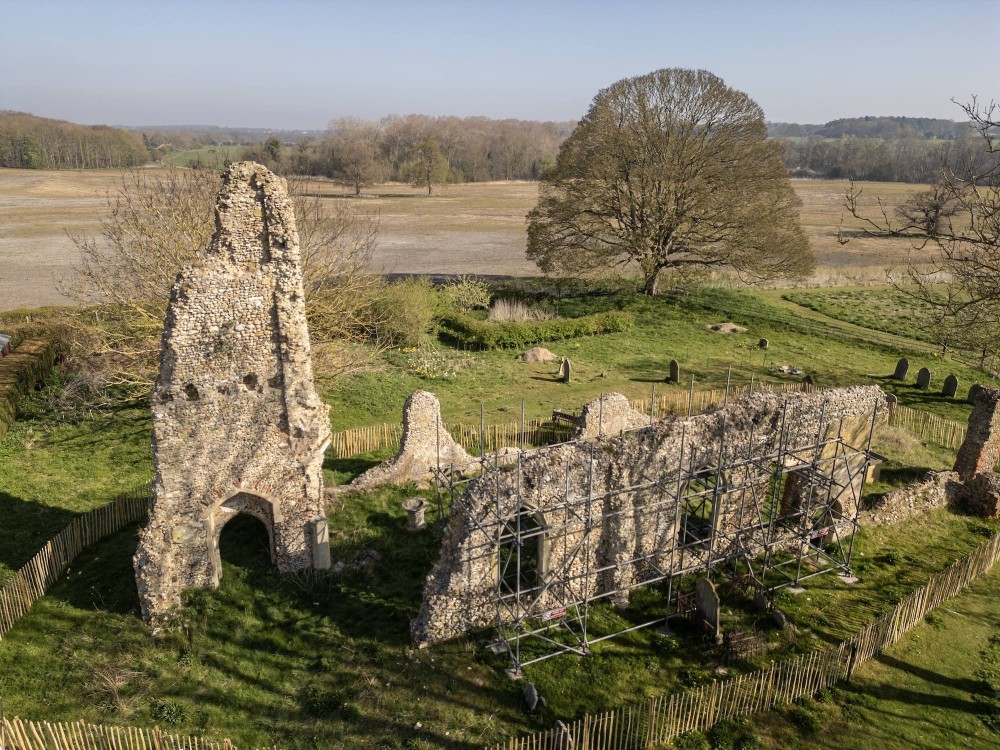
Raynham’s ruins rise again
A site of deep historical significance, the ruins of St Margaret’s Church are entering a new chapter of preservation and revival
Had you ventured into the heart of West Raynham three decades ago in search of one of the estate’s three historic churches, you would have found St Margaret’s completely engulfed by ivy and brambles. Abandoned in the 18th century when its congregation merged with St Mary’s beside the elegant Raynham Hall, the church gradually
fell into ruin. It might have remained that way was it not for the determination of local volunteers, now organised as the St Margaret’s in Ruins Conservation Trust.
Formally established in 2024, but active since 2018, this inspiring community conservation group has worked tirelessly to safeguard and revitalise the ruins, parts of which date from shortly after the Norman Conquest. Their mission is not only to preserve the past but also to ensure this remarkable heritage site survives for future generations to admire. With the church designated a ‘Priority A’ site on Historic England’s ‘Heritage At Risk Register’ because of the imminent threat of further deterioration, their work has come at a critical time.
“The ruins were first stabilised around 25 years ago, with the walls capped to prevent further erosion. However, without additional remedial work, the site remains at risk of collapse,” explains David Stubbs, ecologist and trustee of the St Margaret’s in Ruins Conservation Trust. “The church’s remains are an iconic feature of the village, so losing them would be a huge tragedy – something we simply cannot allow to happen.”
Under the leadership of Chair James Hickman, David and a dedicated team of trustees and volunteers have combined their expertise across a range of disciplines to drive significant improvements over the past eight years. Their achievements include restoring a traditional hay meadow and carrying out ongoing environmental management of the churchyard, transforming the site into a peaceful haven for both people and wildlife.
These projects have helped residents and visitors reconnect with the site’s rich historical and cultural significance. “It’s been particularly rewarding to see the impact on pupils from West Raynham School, who regularly visit St Margaret’s churchyard,” David says. “We’re also incredibly grateful to the Raynham Solar Fund for supporting the initial conservation efforts, and to our dedicated volunteers from the village and beyond.”
Building on this success, the Trust has introduced sheep to graze the site during the winter months and has undertaken extensive biodiversity improvements. Carefully managed wildflower planting and hedgerow restoration efforts now support a wide variety of wildlife, including voles, shrews, frogs, butterflies and numerous bird species.

For a time, the ruins were used for worship once again, but safety concerns eventually halted services within the church itself. Despite this setback, the Trust remains committed to restoring the site and securing its future.
“Scaffolding has been installed to support the fragile ruins and prevent further collapse, with temporary fencing around the church to ensure public safety,” David explains. “For now, services are held in the churchyard, but our long-term ambition is to stabilise the ruins sufficiently to bring them back into use and create a pioneering centre dedicated to heritage preservation.”
In 2024, the Trust secured a two-year grant from The National Lottery Heritage Fund to further develop the project. This funding enabled detailed condition surveys by specialist conservation architects and structural engineers, alongside ecological and archaeological investigations. Additional consultants have advised on activity planning and evaluation, allowing the Trust to prepare its delivery phase application to the Heritage Fund and secure the resources needed for vital long-term work.
“We’ve worked closely with our local community and key stakeholders, including the Norfolk Wildlife Trust’s Churchyard Conservation Scheme, the Norfolk Churches Trust and Raynham Estate, to shape the project,” David continues. “If successful, restoration work should begin in earnest next spring and be completed by the autumn. After that, regular maintenance and monitoring will help ensure the future protection of the ruins.”
The impact of this work could extend far beyond St Margaret’s. With around 150 church ruins scattered across Norfolk, the Trust hopes the project will provide a model for similar initiatives across the county. Their vision includes creating education and training opportunities that equip future generations with valuable heritage, conservation and environmental management skills.
“From teaching stone masonry and restoration techniques to churchyard management and green skills, we aspire to create a Centre of Excellence at St Margaret’s,” says David. “In the meantime, we invite everyone to explore, reflect and enjoy this special place – a site that connects the past with a sustainable future and brings our community together.”
To learn more about the preservation of St Margaret’s Church ruins, volunteer opportunities, fundraising efforts and community events, visit stmargaretsruins.org.