
A landmark full of wonder
Revealing the secrets, stories and splendour of King’s Lynn’s historic Town Hall
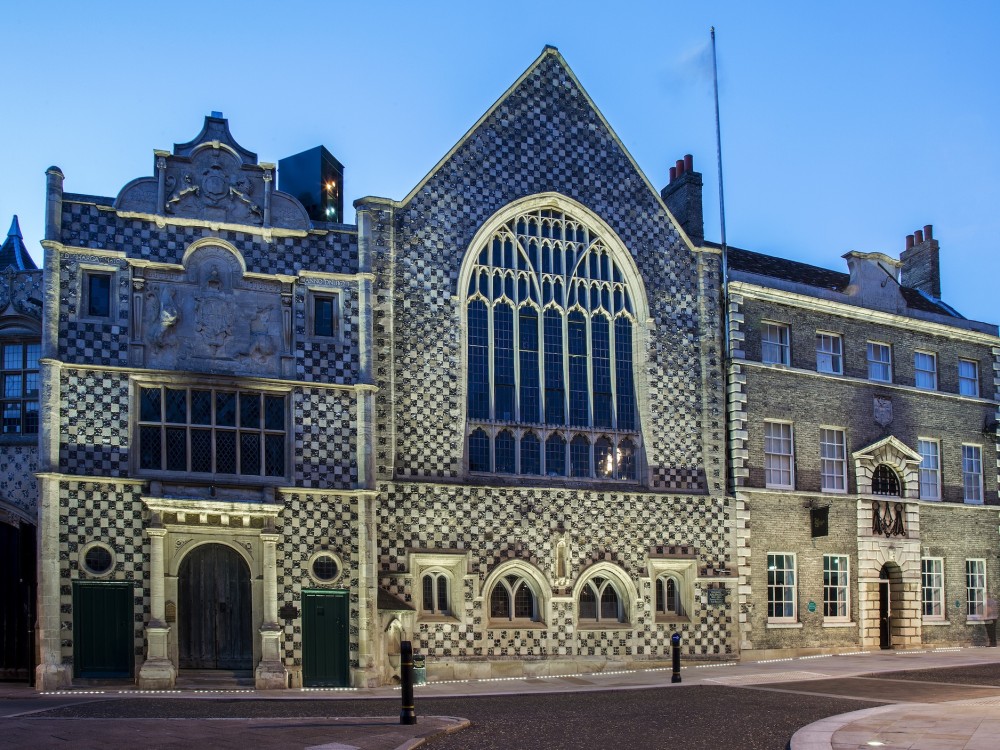
Few buildings in King’s Lynn command attention quite like the iconic Town Hall complex. Its flint and stone façade, ecclesiastical windows and quiet sense of authority have shaped the town’s identity for centuries. Step inside and that impression deepens. This is a place where civic life, ceremony and community have unfolded for more than 800 years: a landmark that has adapted to each era while keeping its stories close.
For Operations Manager Sam Jay, who has spent more than a decade working within the building, the sense of magic never fades. “I love walking through the door each day. There’s such a friendly feel, the team are wonderful and so many tales and treasures lie within these walls,” she says. “The Town Hall is a walk through history. It has been a place of power, pride and authority since Lynn first took shape in the 12th century, and its features chart the town’s development from the late medieval period right through to the present day.”
What we call ‘the Town Hall’ is, in fact, three distinct buildings: the medieval Trinity Guildhall, the 18th-century Gaol and the Victorian Town Hall. Together, they form one of Norfolk’s most architecturally and historically significant civic complexes, each with its own character, its own atmosphere and its own surprises.
The Trinity Guildhall
The oldest of the three buildings, the Trinity Guildhall, was rebuilt between 1421 and 1423 after a devastating fire destroyed its predecessor. Its façade is a striking blend of limestone and flint flushwork, reflecting the wealth and influence of the medieval merchants who once governed Lynn. Religion shaped their world, and the Guildhall’s splendid seven-light window, reminiscent of a church, hints at the spiritual and civic power intertwined here.
Beyond this impressive frontage lies the Stone Hall, the great medieval chamber at the heart of the Guildhall and the oldest surviving civic space in the town. Austere yet atmospheric, its vaulted ceiling and dark panelling carry the weight of centuries of decision-making, feasting and ceremony. The floor, which appears ancient, was laid in 1716 over the original brick undercroft vaulting.
Look closely at the great window and you’ll spot traces of graffiti scratched onto the panes by 18th- and 19th-century workmen. One line, immortalised in glass, reads: ‘Who got the girl with child, poor Billy Turner the glazier!’ - a mischievous whisper from the past.
The entrance hall, added in 1624, carries the coat of arms of Elizabeth I (rescued from the long‑lost church of St James) and, above it, the arms of Charles II. During Cromwell’s rule, the Commonwealth arms sat there instead, a reminder that even the walls have lived through political upheaval.

The Assembly Room
In 1768, fashion and function reshaped the Guildhall. A grand Assembly Room was added, reducing the Stone Hall by 13ft but ushering in a new era of elegance. Where the Stone Hall is solemn, the Assembly Room is theatrical. Chandeliers shimmer overhead, portraits of national figures line the walls and tall windows flood the space with light.
This was a room designed for dining, dancing and society. Gentlemen in powdered wigs, ladies in silk gowns, the hum of conversation and the clink of glassware would once have filled the air. The chandeliers, which cost a modest £135 when first installed, now gleam as priceless treasures. Above the doorway hangs the coat of arms of Queen Victoria, a detail many awestruck visitors miss.
The room once held 24 spittoons and a pewter chamber pot (thankfully no longer required thanks to modern facilities) and was redecorated in 1988 in-keeping with its original colour scheme. Today, it remains one of the most spectacular event spaces in West Norfolk, still used for civic occasions and, when needed, full council meetings.

The Card Room
Beyond the Assembly Room lies the Card Room, a more intimate space where gentlemen once withdrew to smoke, drink and play cards while the ladies remained in the ballroom. It later became the council chamber, a role reflected in its portraits of local notaries and national figures.
Among them is Captain George Vancouver, the King’s Lynn-born explorer who charted the Pacific Northwest with remarkable precision. Nearby hangs a portrait of Fanny Burney, the celebrated novelist and diarist whose sharp observations of Georgian society still resonate. Her father was an organist at the nearby church of St Margaret, and Burney herself once described Lynn as ‘a place of high living rather than high thinking’ - a line that continues to raise a smile.
The Old Gaol House
Built in 1784, the Gaol is one of the most intriguing and unexpected elements of the complex. Its façade, modelled on Newgate Prison, leaves little doubt about its original purpose, although many visitors pass by without recognising its grim history.
Before its construction, prisoners were held beneath the Guildhall in cramped undercroft rooms. The new building provided more space but little improvement in conditions. Its cells, preserved today as part of the Stories of Lynn Museum, remain stark, cold and unsettling. The Gaol stayed in use until 1866, after which it served
as the town’s police station until 1954. The superintendent lived on site, and the building’s corridors once echoed with the daily routines of Victorian law enforcement.
The Town Hall
Completed in 1895, the Victorian Town Hall was designed to harmonise with the medieval Guildhall, mirroring its flint flushwork and ecclesiastical window. By the late 19th century, the corporation had outgrown the older rooms, and increasing public attendance at council meetings required a larger, more modern space.
Inside, the Council Chamber and its outer lobby are lined with portraits of former mayors. Hanging these is a tradition that continues today, although photographs have now replaced oil paintings. The Mayor’s Parlour also remains in use, complete with the oversized chair presented to King Edward VII when he opened the grammar school in 1906. Returned to the town for the mayor’s use, it’s one of the chamber’s most distinctive features.

Other Hidden Treasures
Among the complex’s most treasured delights are its historic books. These vast volumes chart centuries of civic life, ranging from court proceedings to guild records. Many are held in controlled conditions, their leather bindings and delicate handwritten pages offering a tangible link to the town’s administrative past.
This remarkable collection forms part of the King’s Lynn Borough Archive, housed within the Stories of Lynn Museum at the heart of the Town Hall complex. The Archive contains documents dating back to the 13th century, including King
John’s royal charter of 1204, registers of freemen, accounts, minutes and court records. Taking pride of place is the Red Register of 1307 – the oldest complete paper archival book in England and one of the most significant civic records in the country.
The old Clerk’s Office, perched above the main porch, is one of Sam’s favourite spaces. “Very few people ever see it because of access restrictions, but I often stop and imagine what it must have been like to work up there,” she reflects. Its small size and elevated position make it easy to picture clerks sitting at their desks day after day, watching the bustle of the town unfold below.
Architectural details add further layers of character: staircases with diamond-paned windows, carved panelling, heraldic shields and portraits that observe silently from every wall. Each corner reveals something new.
A Living Chronicle
The Town Hall complex is more than a collection of historic rooms — it’s a living chronicle of King’s Lynn itself. From medieval merchants to modern councillors, from prisoners in the Gaol to dancers in the Assembly Room, generations have passed through these spaces, leaving their mark in stone, glass, paint and memory.
“This is such a special place to safeguard. No day is ever the same and I get to witness all kinds of events, from civic ceremonies to beautiful wedding celebrations,”
Sam reflects. “There is so much on show and so much still hidden, and within these walls, both are waiting to be discovered.”
“There is so much on show and so much still hidden, and within these walls, both are waiting to be discovered”
